KaOS 2026.03
KaOS is pleased to release an ISO with a massive change under the hood.
For those interested in the reason why all these changes, please read Systemd and the future of KaOS.
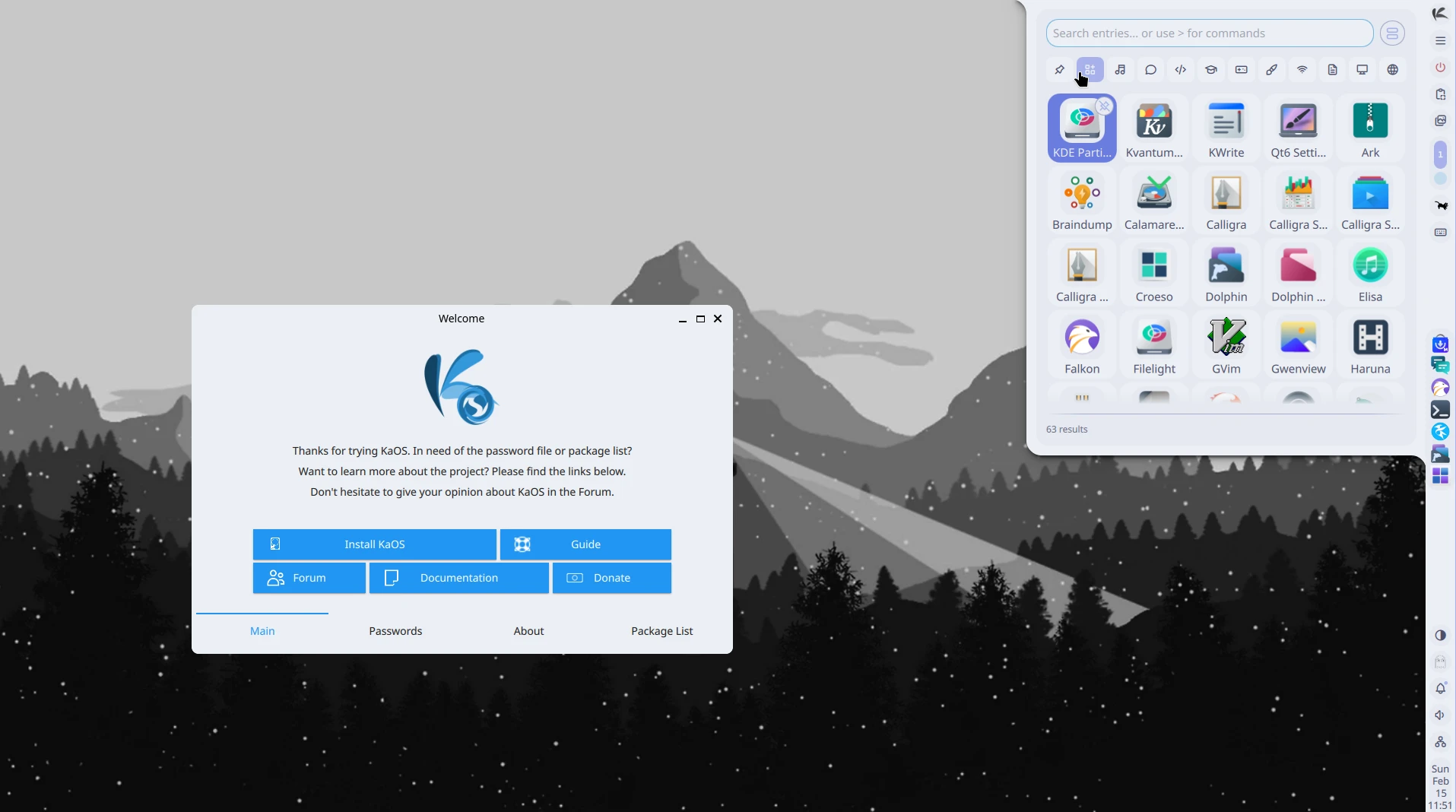
Welcome to a different KaOS
Latest News for this ISO
Though the previous (February) ISO had a big change for the user UI, this time the changes are not so user visible. With this ISO, KaOS has started to remove parts of systemd. Notably, the systemd-boot bootloader is no longer in use. Neither is mkinitcpio (fully systemd-based) in use for initramfs creation. ISO creation is now done using Dracut (and the creation no longer uses any systemd). A change some three years in the making, with a custom Dracut live overlay module to handle the layered setup that KaOS uses for the Live session. Limine is now also the bootloader for the Live session. These were the biggest hurdles that had to be completed before any work to moving to Dinit could really start.
Before anything else, those wishing to look at KaOS in VirtualBox, make sure to understand that VirtualBox does not support Wayland yet, it is still an X11-only app. The only way to workaround this is to use 3d in your settings. Plus VBoxVGA (also X11 only) can’t be used for display, you will need to use VMSVGA, and in CLI set the 3d option:
VBoxManage modifyvm <vm_name> --accelerate3d on. If this is not an option for you, please do not try to use KaOS in VirtualBox, it cannot boot. You will have to wait for VirtualBox to come with Wayland.
You will not find Plasma or Kwin on this ISO, though KaOS has always been a KDE/Plasma only distribution.
Instead, you will find a Niri/Noctalia based system. Work is ongoing to see if a move to Dinit is viable for this distribution, see the above linked news article as to why Plasma is not the best option when moving away from systemd. The system still uses systemd fully, though.
Using Niri with the Noctalia shell has proven to be a nice option. Using these means, KaOS can stay a Qt focused distribution. This ISO is still GTK free, still ships QT/KDE based applications.
Plasma 6 is still fully available in the repositories.
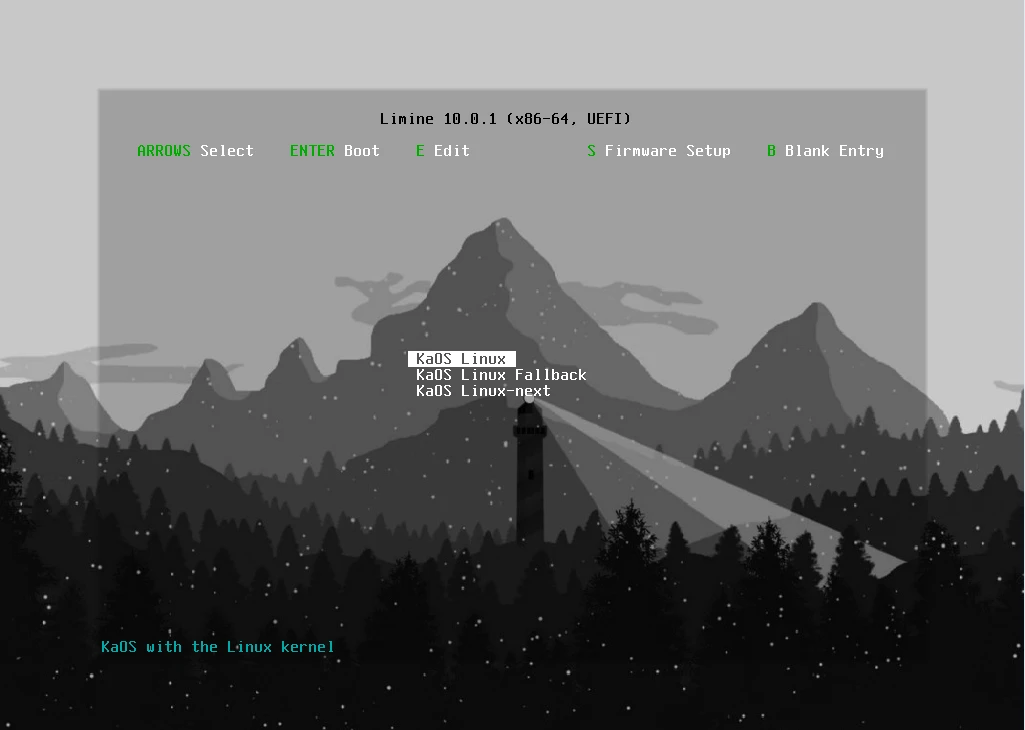
With this ISO, Limine is now the default bootloader. Other options for UEFI installs are still available in Calamares. Systemd-boot is no longer an option.
For the desktop shell, the latest niri (25.11), Noctalia (4.7), and Noctalia Shell (0.0.10) are included. All built on Qt 6.11.0. To complete this setup, options like cliphist, brightnessctl, seatd, ddcutil, pavucontrol-qt, qt6ct and xwayland-satellite are installed.
The installer, Calamares, is now fully ready to run on a pure Wayland system. Changes were needed for the QML modules to have the option to input text again (as is needed in the user creation module, for example).
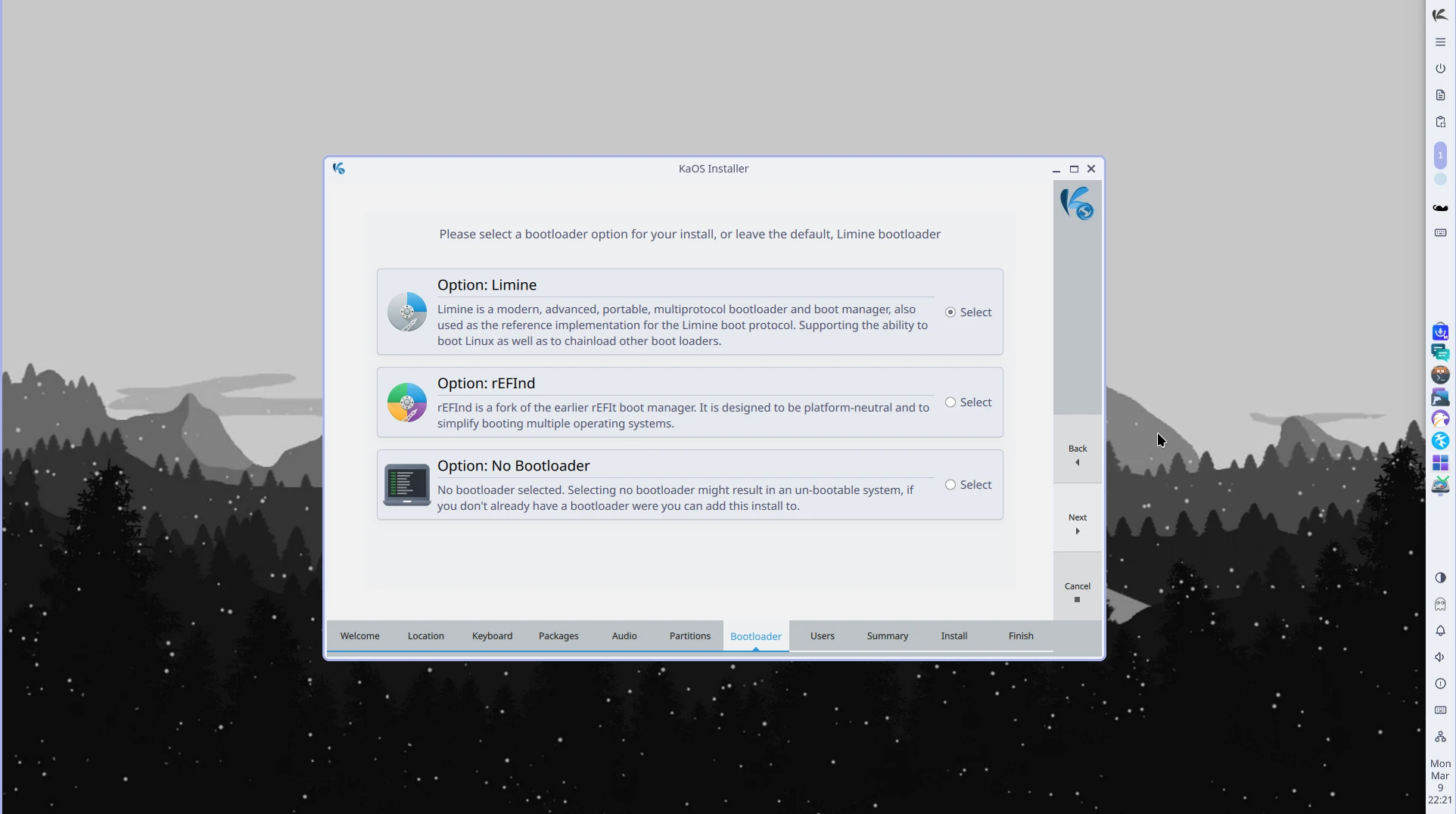 Calamares Bootloader selection
Updates to the base of the system were numerous and included Limine 11.1, Poppler 26.03.0, GStreamer 1.28, Wayland 1.25.0, kernel moved to Linux 6.19.10, Systemd 257.13, ZFS 2.4.1, Cmake 4.3, OpenCV 4.13.0, Xapian-core 2.0.0, Protobuf 34, Libvpx 1.16.0, PManager 0.4.5, and Proj 9.8.0.
Among the new packages included in the ISO are kitty, a modern, hackable, featureful, OpenGL-based terminal emulator, replacing Konsole/Yakuake, since the latter needs Plasma to run properly, Btop, a featureful resource monitor. And Starship, a minimal, blazing-fast, and infinitely customizable prompt for any shell, is added to replace powerline.

Common Notes
A new Phonon sound backend is in use. So far, VLC was used, but there is no Qt6 porting for VLC yet. Using phonon-mpv as default now, gives a fully Qt6-ready backend.
SDDM 0.20.0 added the option to run this display manager in Wayland mode. Wayland is the default for SDDM with the move to 0.21.0.
Getting good logs has always been a bit of a challenge, since you have to know what journalctl commands to use. That is now a thing of the past, Kjournald gives the option to view the logs from a nice GUI, with all kinds of filter options in the left-hand pane (it is now part of the default install).
The automated partitioning option in the installer (Calamares) offers the use of all popular file-systems, so no need to use manual partitioning to be able to choose XFS, EXT4, BTRFS, or ZFS.
Big thanks goes to YourHostingSolutions for not only providing a mirror, but also providing a server for KaOS. With the discontinuation of Fosshost, a new server was sorely needed.
The Linux kernel has all the needed ucode built-in for a fully automated Early Microcode update.
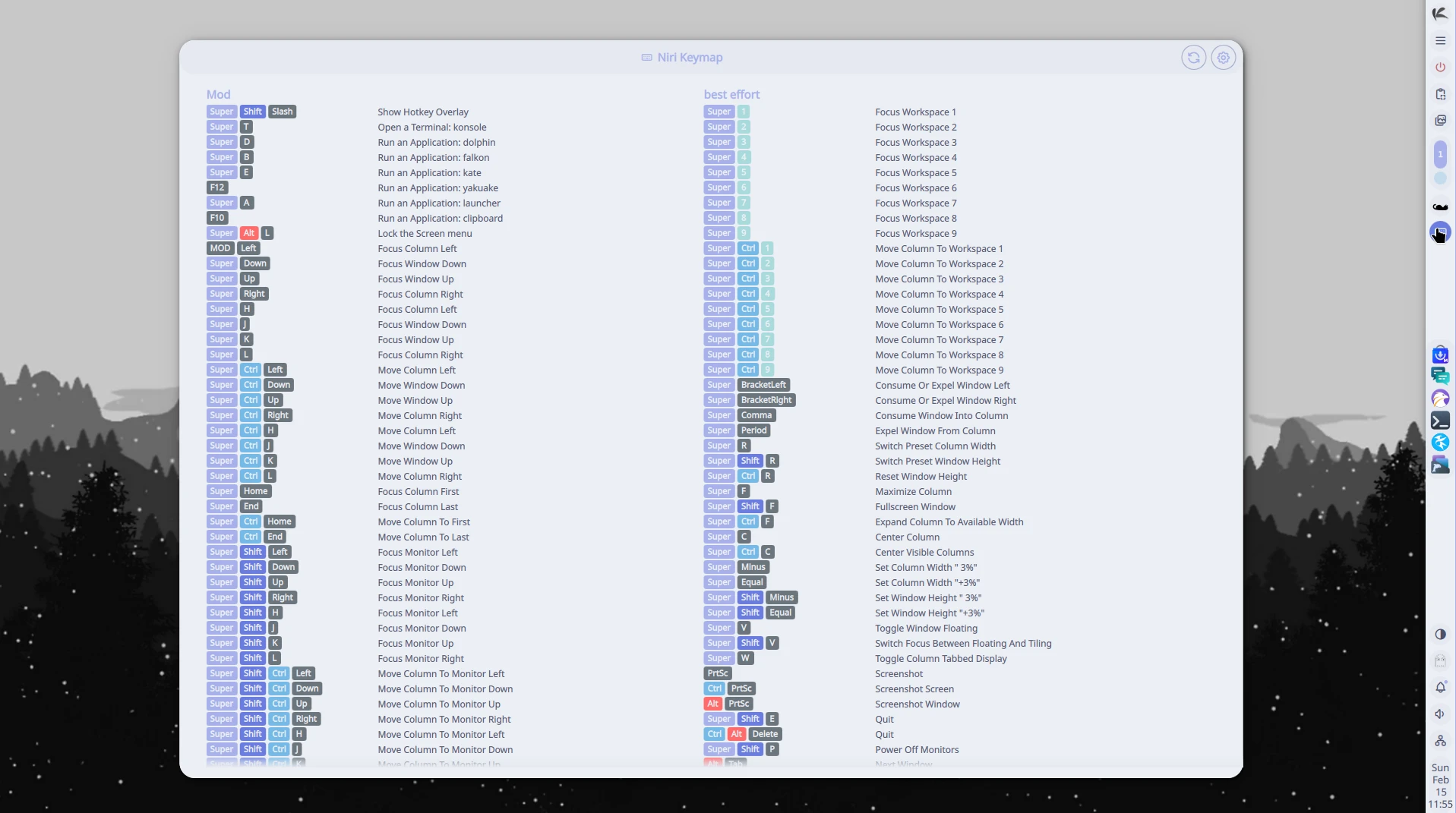 Overview of the niri keymap
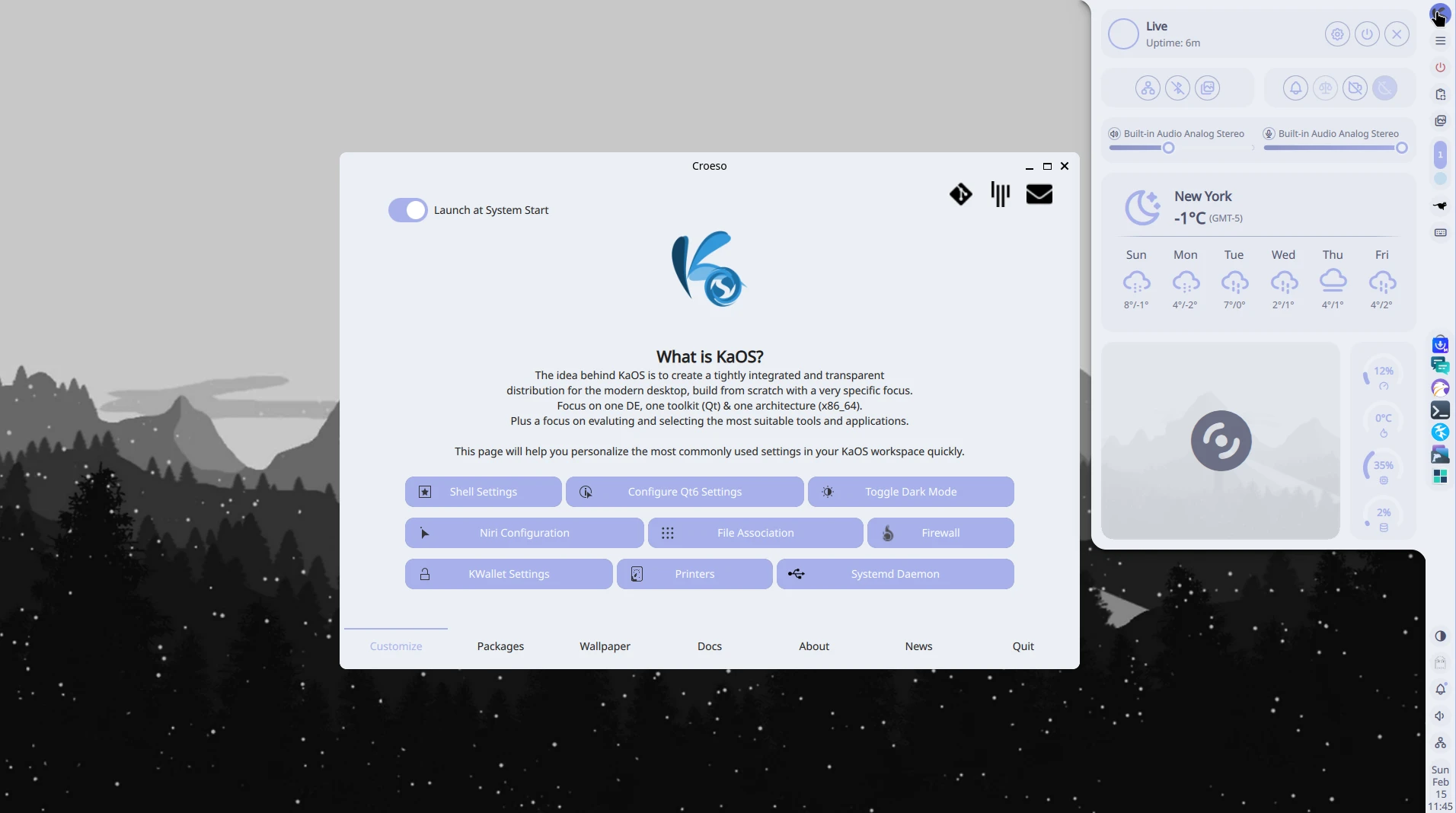
KaOS’s creation Croeso (Welsh for welcome) for helping with configuring a new installation is included. It will run on the newly installed system and offers to adjust some 15 commonly used settings, includes a custom Wallpaper selector, distribution info, and the option to select packages to install from six different groups. It is written in QML and fits well with the Welcome application used in the Live system. The latter includes an Installation Guide.
This ISO uses the CRC and finobt enabled XFS file-system as default. CRCs enable enhanced error detection due to hardware issues, whilst the format changes also improves crash recovery algorithms and the ability of various tools to validate and repair metadata corruptions when they are found. The free inode btree does not index used inodes, allowing faster, more consistent inode allocation performance as file-systems age.
The artwork includes a custom icon theme for light themes. Midna creates a complete, unified look from boot-up all the way through logout.
There is an option to verify the authenticity of downloaded KaOS ISO files through GPG signature verification, see the Download page for further details and instructions.
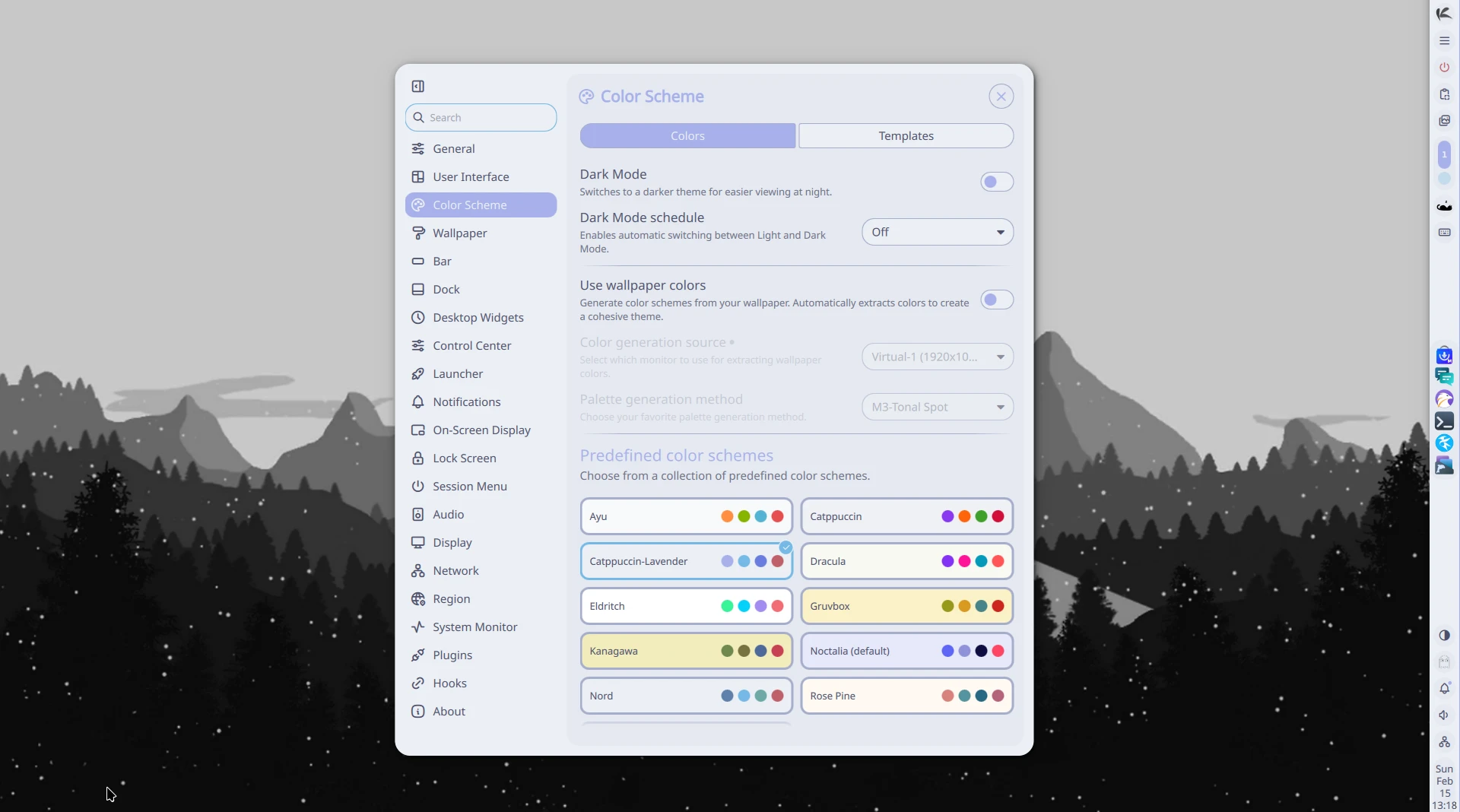 Noctalia Settings
Known issues:
- Installing on RAID is currently not possible
- For BIOS installs, XFS filesystem is not an option, GRUB fails to install with latest XFS
- VirtualBox ONLY supports Wayland when 3d is enabled, thus only VMSVGA can be used
To create reliable installation media, please follow the instructions from the Download page. KaOS ISO’s do not support Unetbootin, Ventoy or Rufus, and DVDs need a burn speed no higher than 4x.